
From Vibe Coding to Spec-Driven Development: How to Ship with AI at Scale
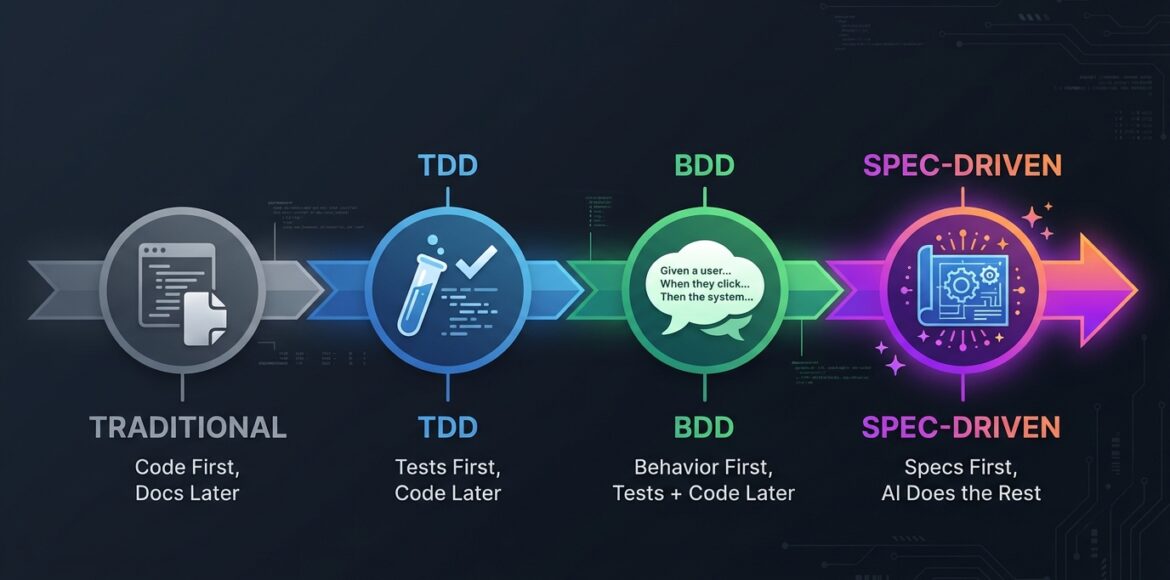
Artificial Intelligence is rapidly transforming how modern software is built. With the rise of AI coding assistants, generative AI development tools, and large language models (LLMs), developers can now build prototypes and deploy features faster than ever before. Platforms powered by AI enable engineers to write code through natural language prompts, accelerating development cycles and reducing repetitive work.
However, while AI-assisted coding dramatically improves productivity, it has also introduced a new workflow often referred to as “vibe coding.” In this approach, developers interact with AI conversationally, generating code through prompts and iteratively refining the output.
Although vibe coding enables rapid prototyping, it can lead to inconsistent architecture, undocumented decisions, and scalability challenges when used for large-scale systems. As organizations adopt AI-driven software development at scale, many engineering teams are shifting toward spec-driven development—a structured methodology that combines the speed of AI with the discipline of traditional software engineering.
In this article, we explore the transition from vibe coding to spec-driven AI development, why it matters for enterprise engineering teams, and how organizations can successfully ship production-grade AI systems at scale.
The Rise of AI-Assisted Development
The emergence of AI-powered developer tools has fundamentally changed the software development lifecycle. Modern coding assistants powered by large language models (LLMs) can generate functions, APIs, infrastructure configurations, and even entire microservices from simple prompts.
Developers can now instruct AI tools to:
- Generate backend APIs
- Build database schemas
- Write automation scripts
- Implement machine learning pipelines
- Create cloud infrastructure templates
This capability has made AI-assisted software engineering one of the fastest-growing trends in modern development environments.
AI tools enable developers to move quickly from idea to implementation. Instead of spending hours writing boilerplate code, engineers can describe the functionality they need and let the AI generate a working solution.
This rapid development workflow has popularized the concept of vibe coding.
What Is Vibe Coding?
Vibe coding refers to a development style where engineers rely heavily on AI prompts to generate code without first defining detailed specifications or architecture.
In this workflow, developers typically:
- Describe a feature to an AI assistant.
- Generate the initial implementation.
- Run the code and observe errors.
- Provide feedback to the AI.
- Iterate until the solution works.
This conversational interaction with AI tools feels intuitive and productive. It allows teams to build prototypes extremely quickly and experiment with new ideas without significant upfront planning.
For startups and early-stage product development, this approach can be highly effective.
However, when organizations attempt to scale this workflow across large engineering teams or enterprise applications, significant problems begin to emerge.
The Limitations of Vibe Coding in Enterprise AI Development
While vibe coding accelerates development, it often introduces structural issues that become more visible as systems grow in complexity.
1. Lack of Architectural Consistency
AI-generated code produced through ad-hoc prompts may not follow a consistent architectural pattern. Without a predefined system design, the codebase evolves organically rather than intentionally.
Over time, this can result in fragmented architecture and technical debt.
2. Inconsistent Coding Patterns
AI tools may generate different solutions for similar problems depending on the prompts used. As a result, teams may end up with multiple implementations for the same functionality.
This inconsistency can make the codebase harder to maintain and debug.
3. Hidden Design Decisions
One of the biggest challenges with vibe coding is that key design decisions often remain inside chat histories rather than documented within the codebase or technical documentation.
When new engineers join the team, they may struggle to understand why certain design choices were made.
4. Feature Scope Drift
Without clearly defined requirements, AI-generated code may introduce unnecessary features or overly complex abstractions.
This phenomenon—known as scope drift—can slow development and increase maintenance costs.
5. Difficulty Scaling AI Development
Enterprise systems require clear documentation, defined workflows, and structured collaboration. Vibe coding alone cannot support large engineering teams working on complex distributed systems.
To address these challenges, organizations are turning toward spec-driven AI development workflows.
What Is Spec-Driven Development?
Spec-driven development is a structured software engineering approach where technical specifications guide the entire development lifecycle.
Instead of writing code first, developers begin by creating a detailed specification that defines:
- Feature requirements
- System architecture
- API interfaces
- Data models
- Testing strategies
These specifications act as a blueprint for both human developers and AI tools.
When AI coding assistants generate code based on clearly defined specifications, the output becomes significantly more consistent, maintainable, and scalable.
How Spec-Driven Development Improves AI Engineering
Spec-driven development transforms AI from a simple code generator into a powerful engineering accelerator.
Let’s compare how developers work in a vibe coding environment vs a spec-driven environment using modern AI coding tools.
Example: Building a User Authentication API
🔹 Vibe Coding Approach
In a vibe coding workflow, a developer might start with a prompt like:
“Create a user authentication API using Node.js with login and signup functionality.”
The AI generates code instantly. The developer then iterates:
- “Add JWT authentication”
- “Fix validation errors”
- “Add password encryption”
Each step improves the output, but:
- Architecture decisions are not documented
- Security practices may be inconsistent
- Code structure can vary across iterations
- No clear alignment with enterprise standards
The result works—but may not be scalable or production-ready.
🔹 Spec-Driven Development Approach
In a spec-driven workflow, the same feature starts with a structured specification before interacting with AI tools.
Step 1: Define the Specification
Feature: User Authentication Service
Requirements:
– User signup and login
– JWT-based authentication
– Password hashing using bcrypt
– Role-based access control
Architecture:
– REST API using Node.js (Express)
– PostgreSQL database
– Separate auth service module
Standards:
– Follow MVC architecture
– Input validation using middleware
– Error handling with centralized logger
Testing:
– Unit tests for auth functions
– API integration tests
Step 2: Use AI Coding Assistant with Context
Instead of vague prompts, the developer now instructs:
“Generate a Node.js authentication service based on this specification.”
Now the AI:
- Follows defined architecture
- Uses consistent coding standards
- Implements security best practices
Aligns with enterprise-ready structure
🔹 How This Works in Popular AI Tools
In modern AI development environments, this spec-driven approach is already emerging:
- AI IDEs (like Cursor / VS Code AI extensions)
Developers store specs in files (e.g., spec.md, architecture.md) and the AI references them while generating code. - LLM-based coding assistants
Engineers include structured specs directly in prompts or system instructions to guide output. - Enterprise AI platforms
Teams define reusable templates for:- microservices
- APIs
- data pipelines ensuring consistency across projects.
- microservices
🔹 Key Difference
Vibe Coding | Spec-Driven Development |
Prompt-based | Specification-based |
Reactive iteration | Planned architecture |
Inconsistent outputs | Standardized code |
Hard to scale | Enterprise-ready |
Why This Matters
By introducing specifications into AI workflows, teams shift from:
➡️ “Generate code and fix it later”
to
➡️ “Define the system and let AI implement it correctly”
This is what enables organizations to scale AI-assisted development across teams, systems, and production environments.
Instead of relying on vague prompts, developers provide structured instructions that guide the AI toward producing reliable implementations.
This approach delivers several advantages for AI-powered software development.
Improved Code Quality
When specifications define architecture and coding guidelines, AI-generated code follows consistent patterns across the codebase.
This reduces bugs and improves maintainability.
Faster Iteration Cycles
Although writing specifications requires initial effort, it significantly accelerates development later in the process.
AI tools can implement entire modules quickly when given clear instructions.
Better Collaboration
Clear documentation and architecture diagrams enable engineering teams to collaborate effectively.
Developers can understand system design without relying on informal chat histories.
Reduced Technical Debt
Spec-driven workflows prevent the accumulation of inconsistent code patterns that often arise from prompt-driven development.
This helps maintain a clean, scalable architecture.
Enterprise-Scale Development
Structured engineering workflows allow organizations to scale AI-assisted software development across multiple teams and projects.
A Modern AI Development Workflow
Organizations building AI-powered applications and cloud-native systems often adopt a development workflow that integrates specifications with AI coding tools.
A typical workflow may include the following stages.
1. Define the Problem and Requirements
The first step is clearly defining the business problem and feature requirements.
This includes documenting:
- Functional requirements
- Performance expectations
- Security considerations
- System constraints
Clear requirements help both developers and AI tools understand the expected outcome.
2. Design the System Architecture
Next, engineers define the architecture of the system.
This may include:
- microservices architecture
- API design
- data pipelines
- cloud infrastructure
- AI model integration
Architecture diagrams help ensure that all components interact consistently.
3. Generate Implementation Using AI
Once specifications are defined, developers can use AI coding assistants and LLM-powered development tools to generate implementations.
AI tools can produce:
- backend services
- REST APIs
- infrastructure as code
- data processing pipelines
- machine learning workflows
Because the AI operates within a defined specification, the generated code aligns with the system architecture.
4. Testing and Validation
Testing ensures that AI-generated code meets quality standards.
Typical testing strategies include:
- unit testing
- integration testing
- performance benchmarking
- automated CI/CD validation
Testing frameworks ensure the reliability of AI-generated implementations.
5. Deployment and Monitoring
Finally, the application is deployed to production environments.
Organizations often use cloud-native deployment pipelines and observability platforms to monitor system performance and detect issues.
AI Engineering at Scale
As AI becomes central to modern software systems, organizations must adopt engineering practices that enable scalable development.
Large enterprises building AI-powered platforms, machine learning pipelines, and cloud-native applications need development workflows that balance speed with reliability.
Spec-driven development provides this balance.
It enables teams to harness the power of generative AI coding tools while maintaining strong architectural discipline.
The Future of AI-Driven Software Development
AI will continue to reshape how software is developed. Advances in large language models, autonomous coding agents, and AI developer platforms will further automate many aspects of the software lifecycle.
However, the most successful engineering teams will not rely solely on AI-generated code.
Instead, they will focus on building structured AI engineering workflows that combine human expertise with machine intelligence.
The shift from vibe coding to spec-driven development represents a critical step in this evolution.
By combining AI-assisted coding with clear specifications, organizations can build reliable, scalable systems while maintaining rapid development cycles.
Conclusion
AI coding assistants have dramatically accelerated software development. Developers can now generate code, build features, and deploy applications faster than ever before.
However, relying entirely on prompt-driven development—commonly known as vibe coding—can lead to inconsistent architecture, undocumented decisions, and scalability challenges.
To build reliable software systems, organizations must combine the speed of AI with structured engineering practices.
Spec-driven development provides the framework needed to achieve this balance.
By defining clear specifications, documenting architecture, and guiding AI-generated code through structured workflows, teams can successfully ship AI-powered software at scale while maintaining high code quality and long-term maintainability.
Tools & Frameworks for Spec-Driven AI Development
As organizations move from vibe coding to spec-driven AI development, several emerging frameworks and tools are helping teams implement structured workflows at scale. These tools enable developers to define specifications, standardize architecture, and guide AI coding assistants more effectively.
Below are some notable resources and frameworks that support spec-driven development in modern AI engineering environments:
1. GitHub Spec Kit
GitHub’s Spec Kit provides a structured approach to defining software specifications before implementation. It helps teams document requirements, architecture, and workflows in a standardized format that can be used alongside AI coding tools.
This approach ensures that AI-generated code aligns with project goals, engineering standards, and scalable system design.
2. Kiro
Kiro is an emerging platform focused on AI-native development workflows. It emphasizes structured planning and specification-driven coding, allowing developers to move beyond ad-hoc prompting and build more reliable applications.
Kiro enables teams to combine AI-assisted coding with clear system design, improving consistency and maintainability.
3. BMad Method
The BMad (Build-Measure-Adopt-Deploy) Method is a structured framework for building scalable software systems with clear development phases. It encourages teams to define requirements, validate assumptions, and iteratively improve systems using a disciplined engineering approach.
This method aligns well with spec-driven AI workflows, especially in enterprise environments.
4. Get Shit Done (GSD Framework)
The GSD framework focuses on execution-driven development with structured planning and rapid iteration. While it supports fast development cycles, it also emphasizes clarity in goals and deliverables—making it compatible with spec-driven approaches.
It helps teams balance speed (AI-assisted coding) with discipline (clear specifications).
5. OpenSpec by Fission AI
OpenSpec is an open-source initiative designed to standardize how developers create and manage software specifications for AI-assisted development.
It provides a framework for defining:
- system requirements
- architecture
- workflows
- integration patterns
OpenSpec enables teams to build consistent, scalable AI-powered systems by ensuring that specifications guide implementation.
Why These Tools Matter
These frameworks represent a broader industry shift toward structured AI engineering workflows.
Instead of relying purely on prompts, teams are increasingly adopting tools that:
- formalize specifications
- standardize development processes
- improve collaboration across teams
- ensure consistency in AI-generated code
This ecosystem is rapidly evolving and will play a critical role in enabling organizations to ship AI-powered applications at scale with reliability and confidence.